

Your cart is currently empty!.
You may check out all the available products and buy some in the shop.
Continue Shopping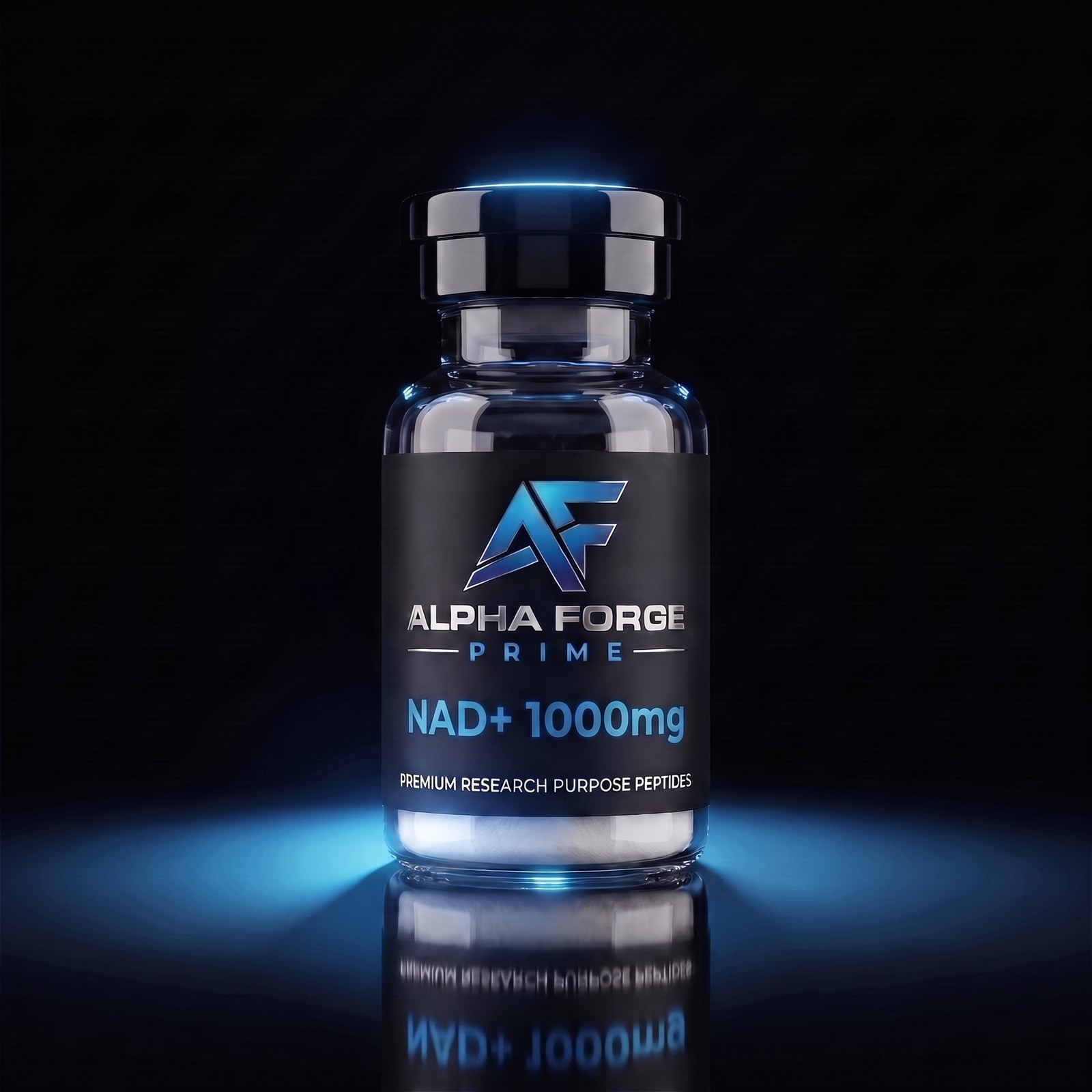


NAD+ 1,000mg is β-nicotinamide adenine dinucleotide in its oxidized form, supplied as a lyophilized powder in a single sealed vial containing 1,000mg net material. NAD+ is a dinucleotide coenzyme, not a peptide; it is listed alongside the peptide catalog because it is characterized and documented the same way. Each lot is analyzed by HPLC for purity; the certificate of analysis for the current lot is shown in the product images and in the COA library.
| Chemical name | β-Nicotinamide adenine dinucleotide, oxidized (β-NAD, DPN, coenzyme I) |
|---|---|
| Structure | Dinucleotide: nicotinamide riboside and adenosine joined through a pyrophosphate bridge |
| Molecular formula | C21H27N7O14P2 |
| Molecular weight | 663.4 g/mol (free acid) |
| CAS number | 53-84-9 |
| Form | Lyophilized powder, white to off-white; hygroscopic |
| Quantity | 1,000mg net material per vial |
| Purity / identity | HPLC purity verified per lot — see the lot-specific COA |
| Solubility | Water-soluble |
| Origin | Produced enzymatically or by fermentation; not a synthetic peptide |
NAD+ was identified in 1906 by Harden and Young as a heat-stable factor required for yeast fermentation, and its structure was worked out by von Euler and by Warburg in the 1930s. It is the central redox cofactor of cellular metabolism: the NAD+/NADH couple carries electrons in glycolysis, the citric-acid cycle and oxidative phosphorylation, and NAD+ is also consumed as a substrate by sirtuin deacetylases, PARP enzymes and the CD38 family. Because of this dual role it is one of the most heavily studied small molecules in biochemistry, and the literature on its cellular metabolism in cultured cells and in animal models is very large. These are laboratory findings in cells and animals; they have not been replicated in controlled human trials, and no conclusions about human effects should be drawn from them.
As a laboratory reagent, NAD+ is chiefly used as a cofactor in enzymatic assays (dehydrogenases, sirtuin and PARP activity assays) and as a reference standard for NAD+/NADH quantification. The practical analytical issues are stability rather than synthesis: the compound is hygroscopic, the nicotinamide–ribose glycosidic bond hydrolyses in neutral-to-alkaline aqueous solution, and the pyrophosphate bridge is susceptible to phosphodiesterase activity, so solutions should be prepared fresh, kept cold and mildly acidic, and quantified by absorbance at 260 nm or by HPLC rather than assumed from mass.
Handling and storage: Lyophilized powder in a sealed vial. Store at −20 °C, tightly closed and protected from moisture and light. Allow the vial to reach room temperature before opening to prevent condensation. Aqueous solutions are not stable and should be used the day they are prepared.
Disclaimer: This product is furnished strictly for in-vitro laboratory research. It is not a drug, has not been evaluated or approved by the FDA, and is not intended for human or animal consumption or for any medical, veterinary, diagnostic, cosmetic or household use. The research background above summarizes the published literature for the benefit of researchers; it does not describe, and must not be read as describing, any effect in or use by humans.
Independent U.S. laboratory testing. Batch-specific certificates below.
| Purity Lot | DPS-2003399 | Endotoxin Lot | DPS-2003399 |
|---|---|---|---|
| Analysis Date | 07/17/2026 | Result | Pass |
Orders are processed within 1–2 business days and shipped USA-only with tracking. Lyophilized peptides are stable at ambient temperature in transit, so no cold chain is required.
Because of the nature of research materials we accept returns of unopened, unused products only, and we make it right on anything damaged or incorrect on arrival — full details in our Refund, Return & Cancellation Policy.
Out of stock

Takes 5 seconds — your cart is saved.
For Research Use Only. Not For Human Consumption.
Alpha Forge Prime
Part of our catalog is reserved for registered researchers. Registration takes under a minute and requires no documents — just a short research-use attestation.